
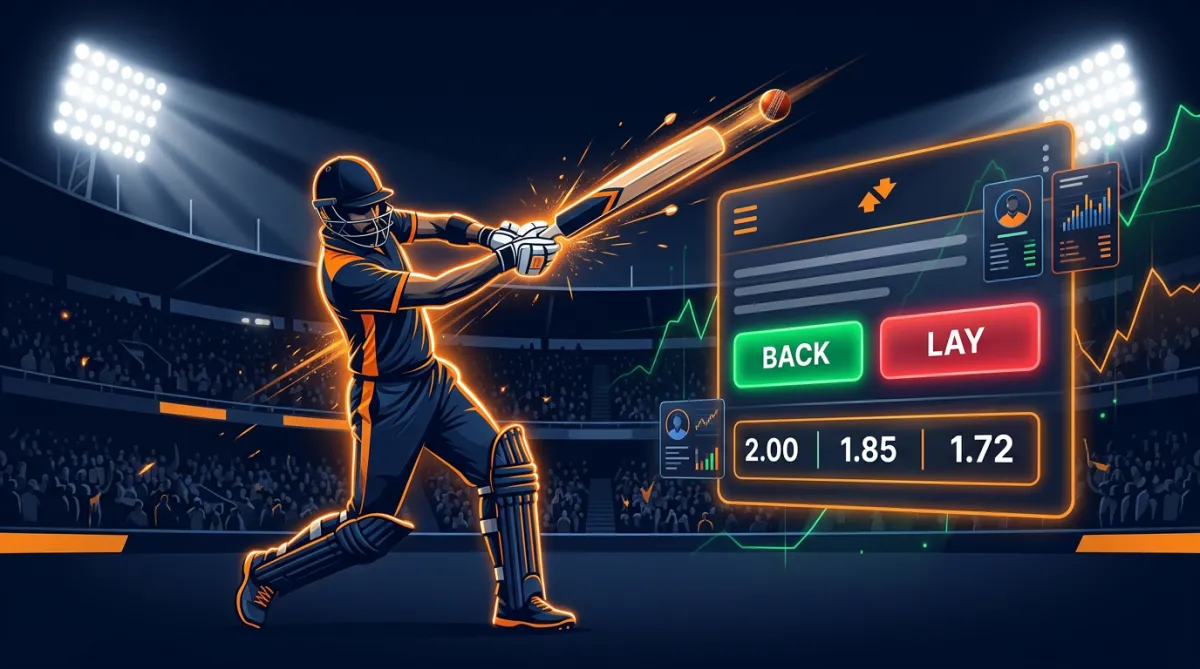
If you are new to cricket betting, you have probably heard the term cricket exchange and wondered how it is different from a normal betting app. The short answer: instead of betting against a bookmaker, you bet against other players at better odds — and you can even act as the bookmaker yourself. This guide explains back and lay betting with simple examples, so you understand exactly what happens before you place your first exchange bet.
What Is a Cricket Exchange?
A betting exchange is a marketplace where players match bets with each other. A traditional bookmaker sets odds and takes the opposite side of your bet; an exchange simply connects two players who want opposite outcomes, and takes a small commission on winnings.
The Funin Exchange app is a cricket exchange and sports exchange — during IPL and international matches you get live ball-by-ball markets with prices that move every second, driven by other players, not by a bookmaker.
The Two Core Moves: Back and Lay
| Term | Meaning | In simple words |
|---|---|---|
| Back | Bet for an outcome to happen | "I think India will win — I'll back India" |
| Lay | Bet against an outcome happening (you act as the bookmaker) | "I don't think India will win — I'll lay India" |
| Odds | The price of a bet (e.g., 2.00) | Higher odds = higher payout, lower chance |
| Stake | The amount you put on a bet | What you risk |
| Liability | What a layer (bookmaker) must pay if the outcome happens | The amount you can lose when you lay |
| Commission | Small % charged on net winnings | The exchange's fee (often 2–5%) |
| Liquidity | Total money available in a market | More liquidity = easier to get your bet matched |
Back Betting — Explained with a Real Example
You back India to win at odds 2.00 with a stake of ₹1,000.
- If India wins → profit = ₹1,000 × (2.00 − 1) = ₹1,000 profit (minus commission)
- If India loses → you lose your ₹1,000 stake
Same logic as any normal bet. Nothing scary here.
Lay Betting — Explained with the Same Example
Now you lay India at 2.00 for ₹1,000. You are saying: "I'll bet AGAINST India winning, and I'll pay anyone who backs India at 2.00."
- If India loses → you keep the ₹1,000 stake put up by the backer = ₹1,000 profit (minus commission)
- If India wins → you must pay the backer their winnings = ₹1,000 × (2.00 − 1) = ₹1,000 loss
Key insight: when you lay, you win when the outcome does not happen. Your worst case is liability (stake × (odds − 1)), not the full stake. That's why laying is a favourite move of experienced players who think a favourite is overpriced.
Why Players Prefer Exchange Odds
Because exchanges connect players directly, odds are typically 5–15% better than bookmaker odds — the bookmaker's built-in margin is replaced by a small commission. During big IPL matches, deep liquidity means your bet is matched almost instantly, even at large stakes.
How to Read an Exchange Market in the App
In the Funin Exchange app (and most exchanges), markets use colour coding:
- Green buttons = BACK (bet for)
- Red buttons = LAY (bet against)
Each price column shows how much money is waiting to be matched at that odds. If your price is available, your bet matches instantly; if not, it sits in the queue until another player takes the other side.
Popular Cricket Exchange Markets
- Match winner — back/lay either team or the draw
- Top batsman / top bowler — player props
- Next over runs / session betting — how many runs in the next over
- Fall of next wicket — over number when the next wicket falls
- In-play markets — prices that update ball by ball during live play
See the IPL 2026 Betting Guide for a full list of markets and how to read them during a live match.
Cricket Exchange vs Traditional Bookmaker
| Factor | Cricket Exchange | Bookmaker |
|---|---|---|
| Who sets odds | Other players (market-driven) | The bookmaker |
| Odds quality | Usually better (5–15%) | Built-in margin |
| Can you lay? | Yes | Rarely/never |
| Win vs loss | You can win when an outcome doesn't happen | Only by predicting correctly |
| Commission | Small % on net winnings | None (but worse odds) |
5 Beginner Mistakes to Avoid
- Not understanding liability before laying — always know your worst-case loss before you click.
- Chasing losses — set a budget and stop when you hit it. Never chase.
- Ignoring commission — factor the 2–5% commission into your math.
- Betting on matches you haven't researched — form, pitch, toss and team news matter.
- Trading without a plan — decide your entry and exit before the market moves.
Frequently Asked Questions
Q1. Is a cricket exchange the same as normal cricket betting?
No. Normal betting is against a bookmaker; an exchange matches you against other players, gives better odds, and lets you lay (bet against) outcomes too.
Q2. What does "back and lay" mean in simple words?
Back = betting for something to happen. Lay = betting against it (acting like the bookmaker and paying out if it happens).
Q3. How much can I lose when I lay a bet?
Your liability = stake × (odds − 1). For a ₹1,000 lay at odds 2.00, your worst loss is ₹1,000 — but at odds 1.50 it's only ₹500.
Q4. Do I need a special ID to use the exchange?
Yes — you use a unique exchange ID from the platform. Get one through the official sign-up process, then log in on the app or website.
Q5. Is exchange betting legal and safe?
Exchange betting, like all real-money betting, is regulated differently by state and country. Always check your local laws. Use only the official app and platform, play responsibly, and never bet more than you can afford to lose.
Q6. Can I trade (back then lay) the same market?
Yes — backing early and laying later to lock in profit is called trading, and it's one of the main reasons players prefer exchanges.
Next Steps
Now that you understand back and lay, the best way to learn is to watch a live market during a real match — start with small stakes. Get the app and Download the Funinexchange APK to follow live IPL and international markets in real time.
Remember: exchange betting is entertainment, not a guaranteed income. Play only if you're 18+, stay within your limits, and stop if it stops being fun. Gambling involves risk — play responsibly.
